• Building a Nieuport 11 replica •
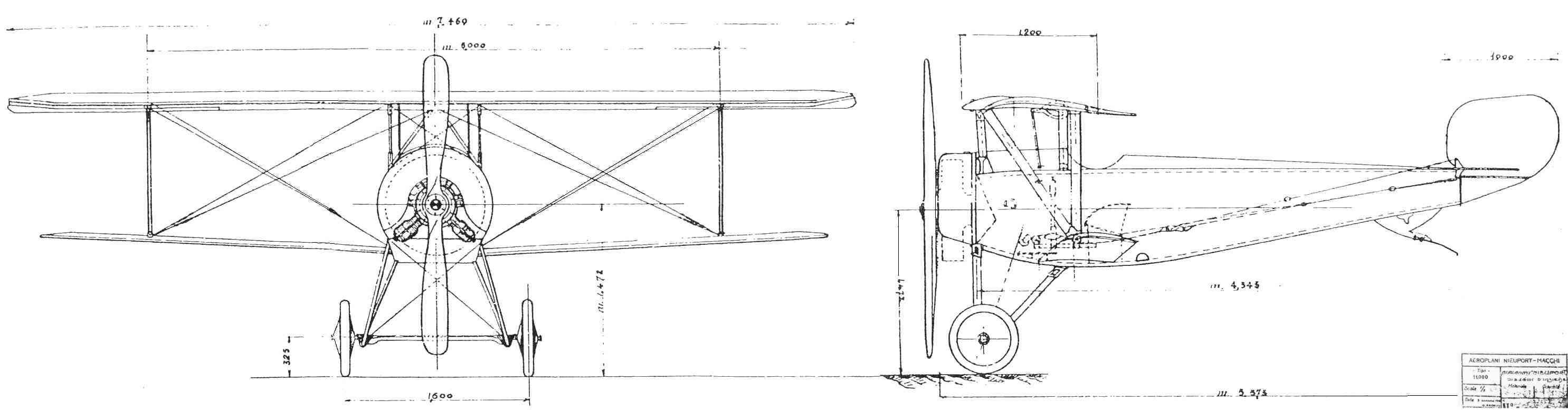
• Introduction •
The Nieuport 11 or Bebe (Baby) was the first in a line of fighter aircraft produced by Societe Nieuport of Issy-les-Moulineaux.
The company had been formed as Nieuport et Deplante by Edouard Nieuport in 1911 but following his death in 1911 after being thrown from an aeroplane it was taken over by Henri Deutsch de la Meurthe and renamed Société Anonyme des Établissements Nieuport.
Gustave Delage became chief designer in January 1914 and started work on a sesquiplane racer. A modified version of this became the Nieuport 10 and saw service with the RNAS, and the French and Russian Flying Services.
In the summer of 1915 an improved design was developed, specifically as a single-seater fighter.
It was initially called Nie-11B to avoid confusion with the Nie XI of 1913 but it soon became known as the 'Baby' Nieuport, by allusion to its small size.
The Nie-11, smaller than the 10, but of very close form, had a wing area of 13 m2 (compared with 18 m2) and a weight in flight of 480 kg (680 kg) but with the same Le Rhone 80 hp engine, which resulted in a much more efficient and above all, much more manageable machine.
Its armament included a Hotchkiss or Lewis machine gun attached to the upper plane and capable of firing above the circle of the propellor helix.
The Nie-11 entered service on the front in early 1916, at a particularly diificult time for the Allies due to the introduction a few monhs before of the German Fokker E.III whose synchonized gun firing through the propellor had wreaked havoc.
The armament of the Nieuport was not as powerful, but the Nieuport was more maneuverable and proved a match for the Fokker.
The Royal Flying Corps did not receive the Nieuport 11, but the Royal Naval Air Service operated the mark.
The American squadron with the French Air Service, the La Fayette, received the Nie-11 in May 1916
In Italy, Nieuport-Macchi and Elettro-Ferroviera built respectively 450 and 93 Nie-11, under the type number 11,000. These aircraft operated between 1916 and 1917.
The Nie-11 was also built in Russia by the Dux factories, and was used by the Belgian Aviation Militaire and Romanian Corpul Aerian Roman.
Following the internment of a RNAS Nie-11 and its pilot in Holland, the Dutch undertook the manufacture of the aircraft in a factory in Trompenburg. 20 were ordered and 12 built, equipped with a Thulin engine of 80 hp, which proved to be unreliable.
These aircraft were delivered in January 1918 and served until 1925.
The Nie-11 was copied in Germany by Euler and Siemens-Schuckert.
Wingspan: 7.5 m
Length: 5.8 m
Surface area: 13 m2
Engine: Le Rhône 80 hp
Empty weight: 320 kg
Weight of fuel: 55 kg
Load capacity: 105kg
Total weight: 480 kg
Flight Duration: 2h